
San Francisco Most Wanted Source
The Sheriff's Office does not maintain its own most-wanted roster. For local fugitives, the public source is the San Francisco Police Department Most Wanted page. Think of it as a curated set of active notices. It is not a roll of everyone with an outstanding warrant. When last checked, it featured a single person in its embedded area, an escaped prisoner sought by the U.S. Marshals, plus a link to a regional Northern California Most Wanted collaboration. Notices come and go as investigations shift.
There is no fixed update schedule. No promised number of entries either. So the date on each notice matters. Always check the live page rather than a screenshot or repost, since a warrant can disappear through recall, an arrest, or court action. A captured view of the SFPD Most Wanted source shows the interface itself.
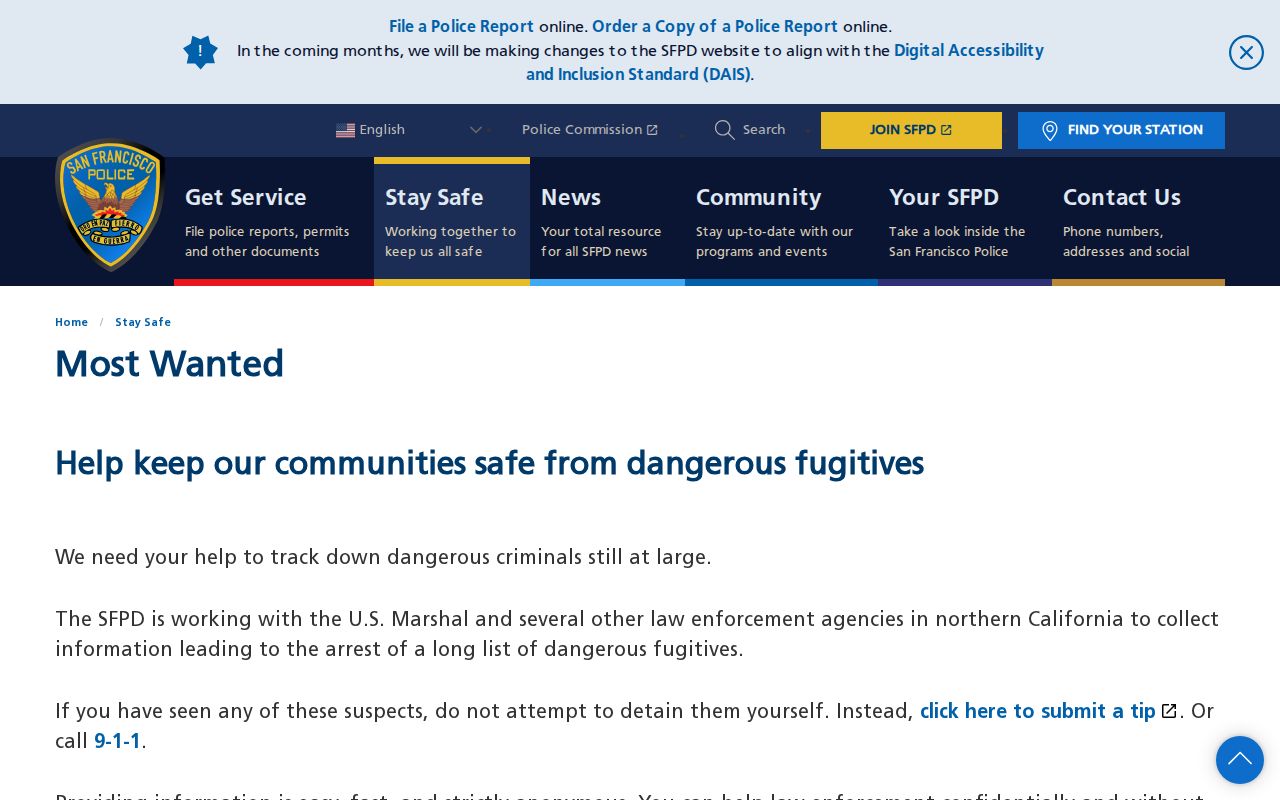
Photographs and wanted details stay on SFPD's own system, where the agency can revise or pull them at will. Nothing is republished here.
Safety first: Do not approach, follow, detain, threaten, or publicly accuse a person shown in a wanted notice. Call 911 only when there is an immediate threat.
San Francisco Wanted Listing Fields
A live notice packs in enough detail to tell the subject apart from someone with a similar name. The exact fields vary by case and by partner agency. On the San Francisco County page, the visible notice included a photo, a personal description, agency attribution, the reason the person is wanted, and a caution warning. Read all of it. A picture alone is never a sound match.
| Field | What the official listing may show |
|---|---|
| Photograph and name | The agency's identification image and the name used in the notice. |
| Age and sex | Basic identifying facts supplied for that wanted person. |
| Physical description | Height, weight, eye color, hair color, and race when included. |
| Issuing agency | SFPD or a named partner, such as the U.S. Marshals, responsible for the notice. |
| Wanted reason | The alleged offense, escape, or other stated basis for seeking the person. |
| Caution language | A specific warning, including an armed-and-dangerous alert when the agency posts one. |
These fields help with identification and nothing more. To learn what a filed case actually says, turn to the San Francisco Superior Court record, which is where the outcome lives.
Note: Match several official fields plus the issuing agency before sending a tip; a name or face alone can lead to a harmful mistake.
Using San Francisco Wanted Notices
The list exists to route information to investigators. It is not a directory for private action of any kind. Start at the official page each time, confirm the notice is still live, and follow whatever instructions come attached to it. Some entries trace back to a regional or federal partner, so the named agency and its tip channel matter.
- Open the current SFPD Most Wanted page and note the posting agency, date, and wanted reason.
- Compare the full physical description and caution text. Do not rely only on a photograph or common name.
- Keep your distance. Do not make contact, announce the charge online, or try to confirm the person's identity yourself.
- Use the tip method printed on the live notice. For an immediate danger or crime in progress, call 911.
- After an announced capture, use the San Francisco County custody and booking paths to check current jail status, while remembering that released people leave the current locator.
Keep a tip to what you saw, where, and when. Skip the assumptions. The agency decides whether the information fits its case. If a notice originated with another agency, use that agency's stated channel instead of blasting the same report to unrelated offices.
Why San Francisco Warrants Stay Selective
San Francisco County keeps its public wanted notices separate from internal warrant operations. SFPD picks a small handful of matters for display. Behind the scenes, the Sheriff's Central Records and Warrants unit processes warrants from the Superior Court, the District Attorney, juvenile matters, grand-jury indictments, civil body attachments, and Sheriff work-alternative programs, along with release paperwork and bail. None of that work adds up to a public name-entry search.
The Sheriff's 2024 Annual Report offers scale without exposing a single name. It counted 22,799 active outstanding warrants, 9,942 entered, 5,620 returned to custody, and 1,080 recalled. Those are workflow counts for the report year, not a list of unique people, and they cannot tell you whether a specific warrant stands today. A recall simply means a warrant was withdrawn by proper authority, one more reason old posts and third-party claims mislead.
That split is the county's signature pattern. Central Records and Warrants runs the official process out of sight, while the SFPD Most Wanted page handles selective public outreach. Stretch either source into a purpose it was never built for and you will come away with the wrong answer.
Check San Francisco Warrants Safely
San Francisco County has no official portal for a countywide warrant check by name. The Sheriff's old FAQ offered a phone option. It worked only for callers asking about themselves after a missed court date. Staff would not run checks on other people. That guidance has been around a while, so confirm the current procedure before you count on it.
Someone who suspects a warrant in their own name should go through a lawyer or the court itself. A California-licensed attorney can size up the situation and arrange a lawful response. With a case number in hand, the Superior Court Case Information hub leads to the criminal case tools. One catch: that portal searches by case number or attorney name, not by defendant name. So it is no substitute for a real warrant database.
- Collect reliable case details, such as the court number, past court date, issuing court, or paperwork already received.
- Contact a California-licensed attorney or the relevant court. Explain that the goal is to verify and resolve a possible warrant.
- When a case number exists, review the official court history and status through the court's case-information path.
- Confirm any next step with counsel or court staff. Do not trust an unofficial name search as proof of current status.
- Follow the lawful court or attorney instructions for appearance, recall, surrender, bail, or another authorized resolution.
The whole process is built to resolve a warrant, not dodge it. Nobody should treat these channels as a way to avoid service, an arrest, or a court date. If the worry involves a wanted notice rather than papers you already have, counsel can pinpoint the issuing agency and the right court. That keeps a public tip line from becoming a personal clearance service.
Note: The Sheriff's internal warrant check during jail intake or release is not open to the public as a clearance search.
San Francisco Warrant Pathways
The Sheriff's annual report tucks several types of legal process under Central Records and Warrants. They do not all start in the same office. Some are not ordinary criminal arrest warrants at all. That matters, because knowing where a warrant came from tells you or your attorney exactly which authority to call. When it counts, the live court file or the issuing document controls.
| Warrant type or source | Correct verification route |
|---|---|
| Superior Court warrant | Use the relevant court and counsel; search the official case history when the case number is known. |
| District Attorney matter | Identify the court case or issuing process with counsel rather than relying on a public wanted page. |
| Grand-jury indictment | Follow the issuing court and attorney route because public online detail may be limited. |
| Juvenile matter | Expect confidentiality limits; do not seek it through an adult wanted list. |
| Civil body attachment | Confirm the civil court process and current status with the issuing court or counsel. |
| Work-alternative program | Contact the responsible Sheriff program or counsel for current instructions. |
These categories explain why no single generic warrant search can cover every San Francisco County matter. The issuing court holds the controlling details. So does the case history, along with legal advice. Juvenile records and other protected material may never surface in remote public systems.
San Francisco Warrants and Court Records
A warrant entry and a wanted notice are snapshots, not the final word on a case. The San Francisco Superior Court Criminal Division keeps the full record. That includes arraignments, pleas, hearings, dismissals, diversion, trials, and sentences. Arraignment is where the charge gets stated and rights are addressed. Disposition is the later result.
Search the court's criminal portal with the correct case number. It returns a chronological history, current status, and upcoming events. Name spellings change, and plenty of people share names. So match the court number plus any booking or action number you have. The court also posts a calendar and a cumulative criminal index. Some underlying documents must be reviewed through Criminal Records rather than downloaded online.
After booking at County Jail #1, the Intake and Release Center, a person may show up in the Sheriff's current-custody locator. It is text-based. It works only while the person stays in county custody, and it has no photo field or wanted-person listings. A state prison sentence moves that person into the California Department of Corrections and Rehabilitation system. There, CIRIS tracks current CDCR custody, not San Francisco County warrants.
San Francisco Wanted Tips and Alerts
SFPD's Most Wanted page includes an anonymous tip route. It states that its tip system does not transmit the user's IP address. It promises no reward, though. Separate SFPD investigation releases may direct readers to call 415-575-4444 or text TIP411 with SFPD at the start of the message. Follow whichever notice is live, since a partner agency may give different instructions.
SFPD Wanted Information
Anonymous option: Use the route on the live SFPD wanted notice
Tip line used in SFPD releases: 415-575-4444
Text: TIP411, starting the message with SFPD
Emergency: 911 only for an immediate threat
No verified San Francisco Sheriff mobile app delivers wanted notices or booking photographs. The department's official accounts on Facebook, X, and Instagram post selected agency messages, but none promises coverage of every warrant, arrest, or wanted person. No official "Warrant Wednesday" feature checks out either.
VINE California fills a different need. It sends custody-status notices for participating records once someone enters a covered custody system, but it is not a wanted list or photo archive. AlertSF handles citywide emergencies, not person-level warrants. Use each alert for its stated purpose, and go back to the issuing agency or court for current status.